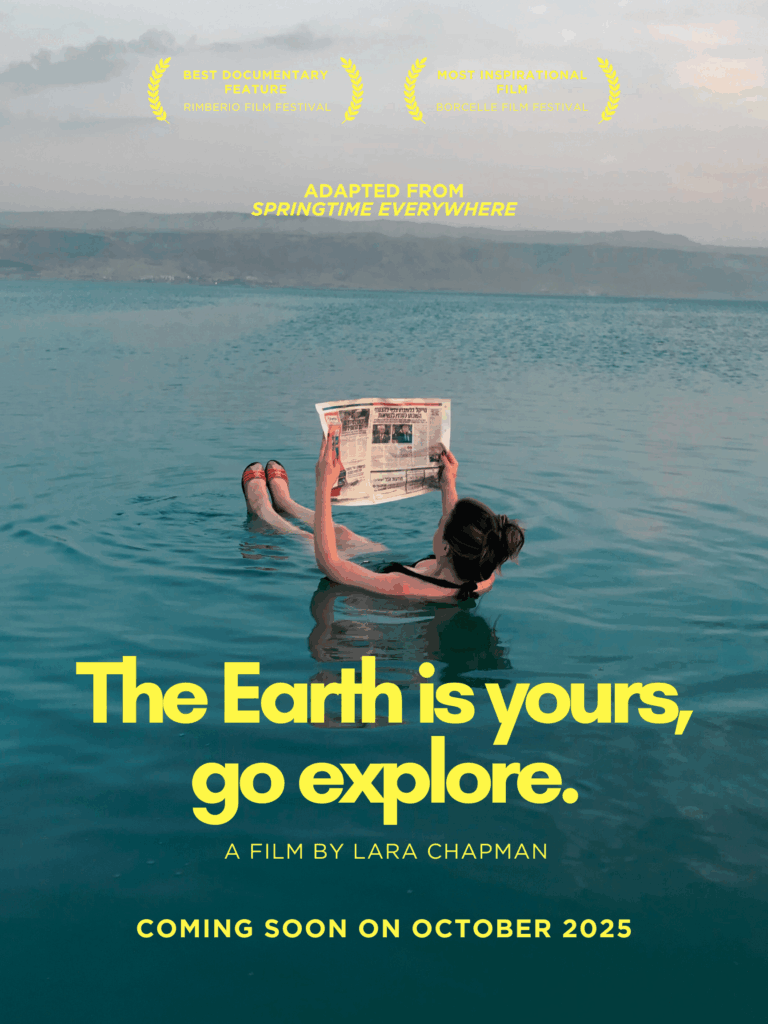
“’The Earth is yours, go explore.‘ It’s as though you have suddenly become a consumer of Earth rather than one of its inhabitants.”
— Lara Chapman, Springtime Everywhere
My poster is based on Lara Chapman’s Springtime Everywhere, specifically the line: “The Earth is yours, go explore. It’s as though you have suddenly become a consumer of Earth rather than one of its inhabitants.” This quote captures the tension between exploration and consumption, the way modern technology and media turn the planet into something to be visually consumed rather than lived within. I wanted the poster to embody that contradiction: an image that looks peaceful and inviting on the surface, yet subtly critiques the very act of seeing Earth as a product.
For the graphical composition, I chose the image of a person floating in the water reading a newspaper. It’s serene and picturesque, the kind of image often found in travel ads or social media posts that turn natural experiences into aesthetic commodities. The stillness of the water and the leisure of the reader suggest comfort and detachment, as though the Earth is simply a backdrop for personal pleasure. This visual works metaphorically with Chapman’s critique, suggesting how our relationship with the planet has drifted toward passive consumption rather than active inhabitation.
The typography reinforces this dual tone. I used a bold, rounded sans-serif font for the main quote to evoke a sense of optimism and adventure, mirroring the familiar language of tourism campaigns. The vibrant yellow text contrasts against the calm blue water, catching the viewer’s eye immediately, as advertisements are designed to do. By placing the quote in this commercial, almost promotional format, I aim to highlight the irony that Chapman identifies that the encouragement to “explore” has become an invitation to consume.
The layout and hierarchy of text also mimic movie posters that sell inspiration and wanderlust. The awards at the top and the release date at the bottom complete the illusion of a commercial product, which further underscores the theme of commodification. Even the tagline “A Film by Lara Chapman” and the line “Adapted from Springtime Everywhere” give the poster a polished, cinematic appeal that contrasts with the subtle critique embedded within the quote.
Ultimately, every element from the tranquil image to the bright, persuasive typography works to blur the line between authenticity and advertisement. The poster looks like it’s celebrating exploration, but beneath that aesthetic appeal, it’s questioning whether we’ve mistaken seeing the world for actually being part of it.